Success Stories: Real Fleets, Real Savings Through Strategic Safety Investments
Theory and strategy are valuable, but nothing drives home the power of proactive safety and insurance management quite like real-world success stories. These aren’t hypothetical scenarios or best-case projections—these are actual carriers who implemented the strategies we’ve discussed and achieved measurable, substantial results.
Each of these case studies demonstrates a critical principle: investing in safety and operational excellence doesn’t just prevent accidents—it generates genuine ROI through reduced insurance costs, lower claims, and improved operational efficiency.
Case Study #1: Roger Hoene and 3 Sisters Logistics – How One Dash Cam Prevented a Career-Ending Claim
The Situation
Roger Hoene had been driving trucks professionally for 43 years without a major incident. He was the kind of experienced driver every fleet wants—professional, safe, and reliable.
On what seemed like a perfect driving day—bright, sunny, ideal conditions—a pickup truck pulled out from a private driveway directly into Roger’s path without stopping. Despite decades of experience and quick reflexes, there was no time to stop. Roger swerved to avoid the collision, but his truck rolled as a result.
In previous eras, this would have become a he-said-she-said situation. The other driver could have claimed Roger was speeding, not paying attention, or driving recklessly. Even if Roger was completely vindicated, the legal process could have dragged on for months or years, accumulating costs and stress.
The Technology Solution
3 Sisters Logistics had equipped their fleet with integrated dash cams from Lytx Surfsight and telematics from Geotab. These systems captured:
- High-definition video showing the pickup truck pulling out without stopping
- Telemetry data confirming Roger’s speed and braking response
- GPS location and route history
- Complete vehicle diagnostics at the moment of impact
The Outcome
Within moments of the accident, 3 Sisters Logistics had irrefutable evidence of what happened. The investigating police officer watched the video footage and immediately stated that Roger’s quick thinking “likely saved this kid’s life.”
The insurance company reviewed the evidence and just as quickly cleared Roger of all fault. What could have been a $150,000 to $200,000 claim—or potentially much worse if it had gone to litigation and resulted in a nuclear verdict—was resolved with minimal cost to the carrier.
The Transformation
Perhaps most significantly, Roger—who had initially resisted having cameras in his truck—became an advocate for the technology.
“I wasn’t a big fan of putting cameras in trucks to begin with. I’m old school,” Roger admitted. “But it turned out to be a good thing for me.”
Key Takeaways
For Carriers:
- Video evidence can resolve incidents in hours rather than months or years
- Technology protects professional drivers from false accusations
- One prevented major claim can pay for fleet-wide technology installation
- Driver acceptance improves dramatically after seeing the technology work
For Insurance:
- Insurers settle claims more quickly when evidence is clear
- Video reduces litigation costs and uncertainty
- Carriers with comprehensive camera systems earn premium discounts
- One exoneration justifies the entire technology investment
Investment vs. Return:
- Dash cam system cost: ~$500-$800 per truck
- Potential claim prevented: $150,000-$200,000+
- ROI: Immeasurable in this case—the system paid for itself hundreds of times over
Case Study #2: D.M. Bowman Inc. – 20% Accident Cost Reduction Through Integrated Telematics
The Challenge
D.M. Bowman Inc., operating a 325-truck fleet, faced the common challenge of managing safety across a large, geographically distributed operation. Traditional safety management approaches—periodic reviews, after-the-fact coaching, and annual performance discussions—weren’t providing the real-time visibility and intervention capabilities needed to prevent incidents.
The Strategy
The company implemented Geotab’s integrated telematics solution across their entire fleet, creating a comprehensive safety management platform that included:
Real-Time Data Monitoring:
- Continuous tracking of vehicle speed, braking, acceleration, and following distance
- Immediate alerts for unsafe driving behaviors
- GPS routing and location monitoring
- Engine diagnostics and vehicle health tracking
Proactive Safety Management:
Retry
AF
Continue
Continuing Blog Post 8…
Proactive Safety Management:
- Automated reports highlighting risky behaviors by driver
- Risk pattern identification across the fleet
- Data-driven coaching opportunities
- Performance trending over time
Incident Investigation:
- Comprehensive data available for any incident
- Ability to verify driver behavior during accidents
- Evidence for insurance claim resolution
- Root cause analysis capabilities
The Results
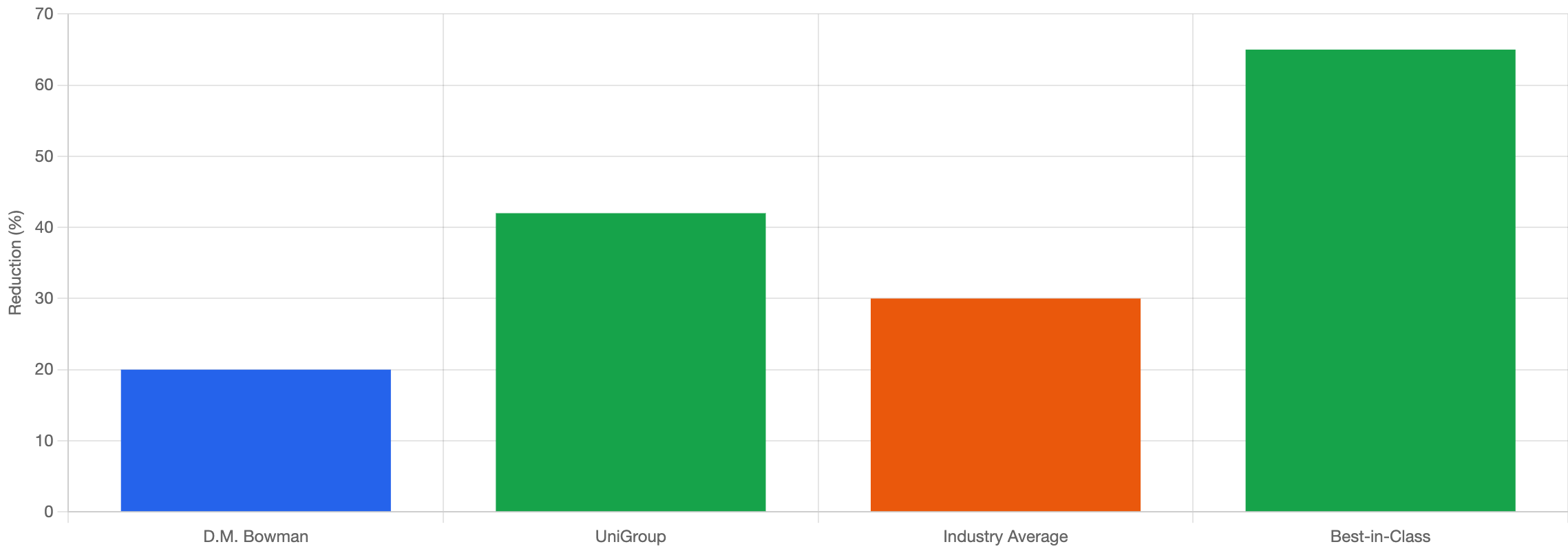
20% Reduction in Accident Costs: Within the first year of implementation, D.M. Bowman achieved a 20% reduction in accident-related costs. This translated to hundreds of thousands of dollars in savings for the operation.
Improved Safety Culture: Real-time data allowed safety managers to address unsafe driving behaviors immediately rather than waiting for incidents to occur. Drivers received coaching based on objective data rather than subjective observations.
Enhanced Insurance Positioning: The comprehensive safety program and demonstrable results strengthened the company’s position with insurance carriers, helping moderate premium increases in a challenging market.
Operational Benefits: Beyond safety, the telematics data provided insights for:
- Route optimization
- Fuel efficiency improvements
- Maintenance scheduling
- Customer service enhancements
Key Takeaways
For Carriers:
- Real-time visibility enables proactive safety management
- Data-driven coaching is more effective than reactive discipline
- Comprehensive telematics provides benefits beyond safety
- Large fleets can achieve consistency across distributed operations
For Insurance:
- Telematics data provides objective evidence of safety culture
- Companies with comprehensive monitoring demonstrate commitment to loss prevention
- Real-time intervention prevents incidents before they occur
- Integration across the fleet shows systematic approach to risk management
Investment vs. Return:
- Telematics cost: ~$25-$50 per truck per month
- Annual cost for 325 trucks: ~$97,500-$195,000
- Accident cost reduction (20%): Likely $300,000-$500,000+ annually
- Net annual benefit: $200,000-$400,000+
- Payback period: 3-6 months
Case Study #3: UniGroup – 42% Reduction in Safety Events Through In-Cab Coaching
The Company
UniGroup is a transportation cooperative handling one-third of all professional moves in the United States—a massive operation with high visibility, demanding customers, and complex logistics challenges.
The Problem
Like many large carriers, UniGroup faced the challenge of maintaining consistent safety performance across a diverse fleet handling sensitive household goods. Safety incidents not only created insurance costs but also damaged customer relationships and the company’s reputation.
The Solution
UniGroup deployed dash cam systems with AI-powered in-cab alerts across their fleet. The system provided:
Real-Time Driver Coaching:
- Immediate audio/visual alerts for unsafe behaviors
- Forward collision warnings
- Lane departure alerts
- Following distance notifications
- Speed limit reminders
Positive Reinforcement:
- Recognition for safe driving behaviors
- Performance scoring visible to drivers
- Competition and gamification elements
- Rewards for sustained excellence
Data-Driven Management:
- Detailed reports on safety events by driver
- Trending and pattern identification
- Targeted coaching opportunities
- Verification of improvement over time
The Remarkable Results
42% Reduction in Safety Events in One Year: This dramatic improvement came from a single intervention—implementing dash cams with real-time coaching capabilities.
The key wasn’t surveillance or punishment. It was immediate feedback that allowed drivers to correct behaviors before they became patterns or led to incidents.
The Science Behind the Success
Research shows that simply being watched doesn’t create lasting behavioral change—drivers adjust for a week or two, then revert to previous habits. What works is immediate, specific feedback tied directly to behaviors.
When a driver receives an alert the instant they follow too closely or exceed the speed limit, they can correct immediately. Over time, these micro-corrections become new habits, and the safer behaviors become automatic.
Key Takeaways
For Carriers:
- In-cab alerts are more effective than after-the-fact coaching
- Positive reinforcement drives better results than punishment
- Technology enables consistent coaching across large fleets
- Immediate feedback creates lasting behavioral change
For Insurance:
- 42% reduction in safety events translates to dramatically lower claim frequency
- Proactive systems demonstrate serious commitment to loss prevention
- Data-driven coaching shows systematic approach to safety
- Carriers with these systems represent significantly better risks
Investment vs. Return:
- Dash cam systems with AI coaching: ~$500-$1,000 per truck
- For a 1,000-truck fleet: $500,000-$1,000,000
- 42% reduction in safety events: Likely $2,000,000-$5,000,000+ in prevented costs
- Insurance premium impact: Substantial discounts and better terms
- Payback period: Less than 6 months
Case Study #4: Small Regional Carrier – Retention Strategy Transforms Insurance Profile
The Starting Point
This 15-truck regional carrier was struggling with the industry’s typical challenges:
- 85% annual driver turnover
- Three preventable accidents in 12 months
- Insurance premiums increasing 40% at renewal
- Difficulty attracting and retaining quality drivers
- Customer complaints about inconsistent service
The owner was considering selling or shutting down the business due to unsustainable insurance costs.
The Comprehensive Intervention
Rather than accepting the situation, the owner implemented a multi-faceted retention and safety strategy:
Compensation Improvements:
- Increased driver pay by 12% to match top regional competitors
- Implemented safety bonus program with quarterly payouts
- Enhanced health insurance benefits
- Created retention bonuses at 1-year, 3-year, and 5-year anniversaries
Quality of Life Enhancements:
- Guaranteed all drivers home every weekend
- Improved route assignments to balance desirable and challenging runs
- Created predictable schedules allowing family planning
- Installed APU units for better comfort during breaks
Equipment Upgrades:
- Replaced older trucks with units less than 5 years old
- Added modern safety features and comfort amenities
- Implemented rigorous preventive maintenance program
- Upgraded to comprehensive dash cam systems
Culture Changes:
- Created driver mentoring program pairing new hires with veterans
- Implemented monthly safety meetings with driver input
- Launched driver recognition program
- Established open-door policy for concerns and suggestions
The Total Investment
The retention initiatives cost approximately $85,000 annually—a significant increase for a small carrier. Many would have viewed this as unaffordable.
The Transformation: 18 Months Later
Driver Retention:
- Turnover dropped from 85% to 35%
- Average driver tenure increased from 11 months to 28 months
- Experienced drivers became mentors and recruiters
- Driver referrals became primary source of new hires
Safety Performance:
- Zero preventable accidents over 18 months
- CSA scores improved to well below intervention thresholds
- Customers noted dramatic improvement in service consistency
- Equipment maintenance issues decreased significantly
Financial Impact:
- Insurance premiums decreased 15% despite market-wide increases
- Recruiting and training costs reduced by $65,000 annually
- Eliminated downtime from unseated trucks: $40,000 annually
- Improved customer retention: immeasurable but significant
The ROI:
- Annual investment in retention: $85,000
- Insurance savings: $22,000
- Reduced turnover costs: $65,000
- Eliminated downtime: $40,000
- Net annual benefit: $127,000+
- ROI: 150%
What Changed the Insurance Equation
When the carrier approached renewal after 18 months:
They presented insurers with:
- Dramatically improved driver tenure statistics
- Zero preventable accidents over the period
- Comprehensive safety technology implementation
- Documented driver training and development programs
- Strong CSA scores across all categories
- Customer testimonials about service improvements
Insurers saw:
- A carrier that had transformed its risk profile
- Evidence of sustained commitment to safety and quality
- Professional operation with long-term stability
- Drivers who were invested in the company’s success
- Systematic approach to loss prevention
Key Takeaways
For Carriers:
- Retention investments pay for themselves multiple times over
- Comprehensive approaches work better than piecemeal changes
- Cultural transformation takes time but produces lasting results
- Small carriers can compete for quality drivers with better conditions
For Insurance:
- Driver tenure is a powerful predictor of future performance
- Carriers who invest in retention demonstrate long-term thinking
- Zero claims speak louder than promises about safety culture
- Transformation stories create opportunities for better terms
The Owner’s Perspective: “We were ready to close the doors. Insurance costs were killing us, and we couldn’t keep drivers. Investing in retention felt risky—we didn’t have money to waste. But within six months, we could see the difference. Within a year, we had a completely different company. The insurance savings alone paid for a big chunk of the investment, and the operational improvements were even more valuable. We’re not just surviving now—we’re thriving.”
Case Study #5: Mid-Size Fleet – Compliance Excellence as Competitive Advantage
The Opportunity
A 75-truck specialized hauler recognized that new FMCSA regulations for 2025 would create challenges for many carriers. Rather than viewing these as burdens, they saw an opportunity to differentiate their operation.
The Proactive Strategy
Rather than waiting for requirements to take effect, they implemented changes early:
Technology Adoption:
- Installed AEB systems on all trucks (before mandate)
- Upgraded to AI-powered dash cams with ADAS features
- Implemented comprehensive telematics with data sharing
- Added speed limiters set below expected mandate levels
Medical and Drug Testing:
- Moved to hair follicle testing before required
- Implemented electronic medical certification tracking
- Created automated expiration alerts and scheduling
- Zero tolerance policy for any certification lapses
Safety Program Enhancement:
- Developed written policies exceeding minimum requirements
- Created quarterly safety training curriculum
- Implemented driver recognition program
- Established clear career development pathways
Documentation Excellence:
- Systematized all driver qualification files
- Created compliance portfolio for insurer review
- Tracked and reported safety metrics quarterly
- Developed SMS score improvement plans
The Marketing Approach
The carrier actively promoted their compliance excellence:
To Customers:
- “We exceed all 2025 FMCSA requirements today”
- “Our technology and safety programs set industry standards”
- “Zero medical certification lapses, ever”
- “Top 5% safety scores in our category”
To Insurers:
- Comprehensive compliance portfolio
- Documented safety culture and results
- Proactive approach to regulatory changes
- Long-term commitment to excellence
The Results
Insurance Impact:
- Premium increases limited to 5% vs. 20% market average
- Access to preferred carrier markets
- Competitive quotes from multiple insurers
- Lower deductibles and better terms
Business Development:
- Won three major shipper contracts citing safety record
- Commanded premium freight rates
- Reduced customer turnover
- Attracted higher-quality drivers interested in professional operations
Operational Benefits:
- Fewer roadside inspection violations
- Reduced accident frequency and severity
- Improved fuel efficiency from speed management
- Enhanced reputation in the industry
Key Takeaways
For Carriers:
- Early adoption of regulations creates competitive advantages
- Compliance excellence attracts better customers and drivers
- Documentation allows you to prove your value
- Proactive carriers earn better insurance terms
For Insurance:
- Carriers ahead of compliance curves demonstrate sophistication
- Documented programs show commitment beyond minimum requirements
- SMS scores and safety records validate claims of excellence
- Early adopters represent better long-term risks
Investment vs. Return:
- Additional safety technology and programs: ~$175,000
- Premium savings vs. market average: ~$80,000 annually
- Revenue increase from premium contracts: ~$250,000 annually
- Total annual benefit: $330,000+
- Payback period: 6-7 months
Common Themes Across All Success Stories
Looking across these case studies, several patterns emerge:
- Technology Investment Pays for Itself Quickly
Whether dash cams, telematics, or ADAS, safety technology consistently delivers ROI in under 12 months through:
- Prevented claims
- Insurance discounts
- Operational improvements
- Enhanced reputation
- Comprehensive Approaches Work Best
The most successful carriers don’t implement single solutions—they create comprehensive safety and operational excellence programs that address multiple factors simultaneously.
- Documentation Amplifies Impact
Having great programs is important. Being able to prove it to insurers and customers is equally important. Carriers who document their efforts consistently earn better terms.
- Cultural Transformation Takes Time But Lasts
Quick fixes and shortcuts don’t create lasting change. But carriers who commit to genuine cultural transformation around safety and driver satisfaction build sustainable competitive advantages.
- Proactive Beats Reactive Every Time
The carriers achieving the best results don’t wait for problems or requirements—they anticipate, prepare, and implement changes ahead of the curve.
- Small Investments Prevent Large Losses
Every case study shows the same pattern: relatively modest investments in safety, technology, and driver satisfaction prevent exponentially larger costs from accidents, turnover, and premium increases.
What These Stories Mean for Your Operation
These aren’t outlier results achieved by carriers with unlimited budgets or unique circumstances. They’re real-world outcomes from carriers facing the same challenges you face:
- Tight margins
- Insurance pressure
- Driver shortages
- Competitive markets
- Regulatory complexity
The difference isn’t their resources—it’s their approach. They chose to be proactive rather than reactive. They viewed safety and operational excellence as investments rather than expenses. They documented their efforts and used them to demonstrate value to insurers and customers.
Your Next Steps
If these success stories resonate with you, here’s how to begin your own transformation:
Week 1: Assessment
- Honestly evaluate your current safety, technology, and retention programs
- Calculate your true costs from accidents, turnover, and insurance
- Identify your biggest vulnerabilities and opportunities
Week 2: Planning
- Prioritize initiatives based on ROI potential and feasibility
- Develop realistic budgets and timelines
- Create documentation systems for tracking progress
Week 3: Implementation
- Start with highest-impact, fastest-payback initiatives
- Communicate changes to drivers and staff
- Begin documenting efforts for insurer review
Week 4: Measurement
- Establish baseline metrics for safety, retention, and costs
- Create tracking systems for progress
- Share early results with your insurance agent
Ongoing: Continuous Improvement
- Review and refine programs quarterly
- Celebrate successes and learn from setbacks
- Expand successful initiatives across your operation
The Common Objection: “We Can’t Afford It”
Every carrier in these case studies initially worried about affordability. But every one discovered the same truth:
You can’t afford NOT to invest in safety and operational excellence.
The costs of inaction—continued accidents, high turnover, rising premiums, lost contracts, and potential business failure—dwarf the investments required for transformation.
D.M. Bowman invested in telematics and saved 20% in accident costs. UniGroup installed dash cams and reduced safety events by 42%. The 15-truck regional carrier invested $85,000 in retention and netted $127,000 in annual savings.
These aren’t expenses—they’re investments with measurable, substantial returns.
The Bottom Line
These success stories aren’t fairy tales. They’re case studies from real carriers who faced the same challenges you’re facing and chose to respond proactively.
They didn’t have special advantages. They didn’t have unlimited budgets. They didn’t get lucky.
They made strategic decisions to invest in safety, technology, and people. They documented their efforts. They stayed committed through the transformation process. And they achieved results that fundamentally changed their business trajectories.
Your story could be next.
The question is: will you continue with business as usual, or will you implement the strategies that these carriers have proven actually work?
The choice—and the results—are yours.