By Jump Trucking Insurance
In August 2022, a Georgia jury delivered a verdict that sent shockwaves through the entire trucking industry: $1.7 billion against Ford Motor Company in a single case. While that particular case involved a product defect rather than a trucking operation, it perfectly illustrates the legal environment that’s now threatening trucking companies of all sizes—even those with stellar safety records.
Welcome to the era of “nuclear verdicts,” and if you own or operate a trucking company, you need to understand how this phenomenon could impact your business regardless of how safely you operate.
What Exactly Is a Nuclear Verdict?
Industry experts define a nuclear verdict as any jury award exceeding $10 million in damages. In recent years, we’ve seen so many of these massive awards that some are now referring to verdicts over $100 million as “thermonuclear.”
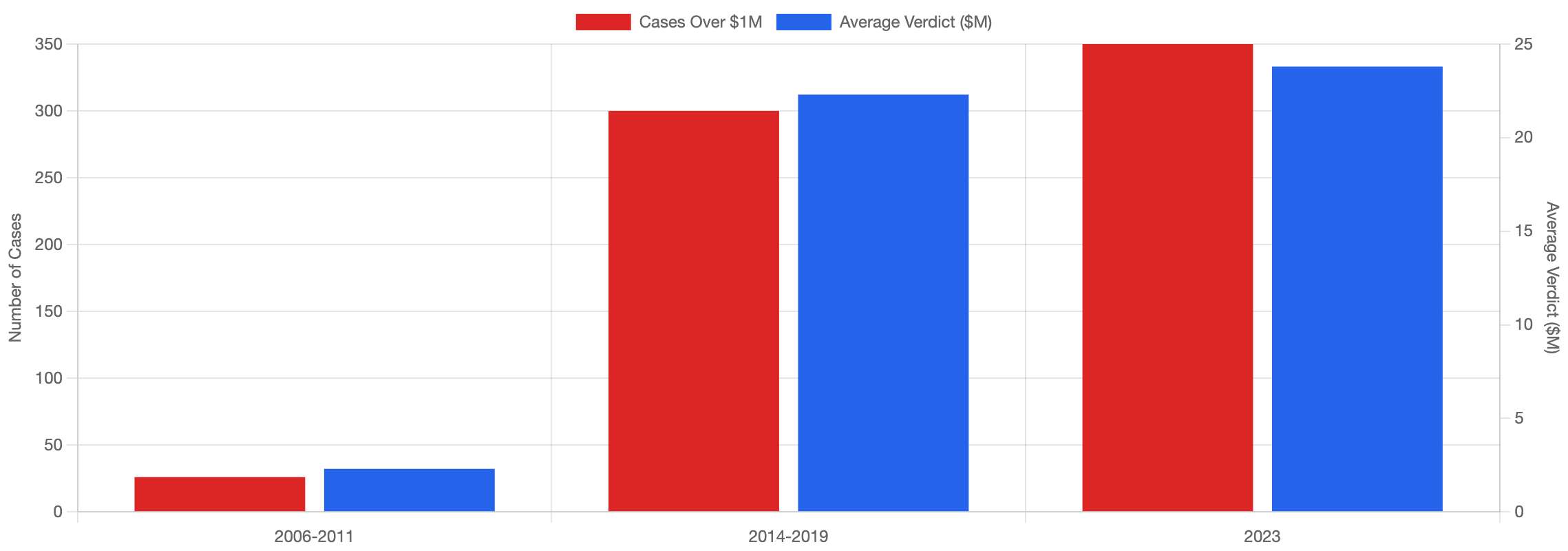
The statistics are staggering:
- From 2006 to 2011, there were 26 cases over $1 million in trucking litigation
- From 2014 to 2019, that number jumped to 300 cases over $1 million
- Between June 2020 and April 2023, the average nuclear verdict award was $27.5 million
- In 2023 alone, 27 verdicts exceeded $100 million
This isn’t a statistical anomaly. It’s a fundamental shift in how trucking accidents are being litigated and judged in American courtrooms.
The Werner Enterprises Case: When Fault Doesn’t Matter
Consider this real-world example that should concern every trucking company owner:
A Werner Enterprises driver was traveling on the highway, driving below the posted speed limit, when a pickup truck suddenly swerved into their path. The investigating police officers found no fault with the Werner driver. The evidence was clear: the truck driver did everything right.
Yet despite these undisputed facts, a jury initially delivered a massive verdict against Werner Enterprises. The case was eventually overturned by the Texas Supreme Court, but only after significant legal costs and the stress of potentially business-ending liability.
This case illustrates a disturbing trend: in many jurisdictions, trucking companies are presumed guilty until proven innocent, and even clear evidence of proper operation may not be enough to avoid a devastating verdict.
The Louisiana Staged Accident Ring: Organized Crime Targets Trucking
Another alarming example of how the legal environment has become hostile to trucking involves a sophisticated criminal enterprise exposed in Louisiana. Beginning in 2011, an organized fraud ring staged accidents with commercial trucks specifically to generate lawsuit payouts.
To date, 63 people have been indicted in the federal investigation, including plaintiff attorneys who are alleged to have been the masterminds behind the scheme. These criminals understood something crucial: trucking companies carry large insurance policies, and the current legal climate makes them easy targets for massive settlements.
This wasn’t just a few opportunistic criminals—it was an organized, systematic exploitation of the trucking industry’s vulnerability in the civil litigation system.
Why Is This Happening Now?
Several factors have converged to create this perfect storm:
The “Reptile Theory” in Action
Plaintiff attorneys have adopted sophisticated trial strategies that appeal to jurors’ emotions rather than facts. The “Reptile Theory” of litigation encourages attorneys to make jurors feel personally threatened by the defendant’s actions, triggering a primal, emotional response rather than a logical evaluation of fault.
In trucking cases, this often means pointing to factors completely outside the scope of the actual accident—such as a company’s overall safety culture, previous incidents involving different drivers, or employee turnover rates—to paint the trucking company as a danger to the community.
Third-Party Litigation Funding
The rise of third-party litigation funding has poured gasoline on the fire. Investment firms now treat civil lawsuits as speculative commodities, fronting litigation costs in exchange for a portion of the settlement or verdict.
This $400 billion global industry (with the United States as its largest market) means that even weak cases can be pursued aggressively, as the plaintiff has no personal financial risk. The result? More lawsuits, longer litigation, and higher settlement demands.
Social Inflation
“Social inflation” refers to the trend of juries awarding increasingly larger damages beyond what traditional economic factors would justify. Several factors contribute:
- Declining trust in corporations
- Rising healthcare costs creating larger medical damages
- Increased attorney advertising that primes potential jurors to view trucking companies as “deep pockets”
- Litigation tactics that inflate pain and suffering awards
Anti-Trucking Bias
Perhaps most frustrating for professional drivers and carriers, there’s evidence of systematic anti-trucking bias in the legal system. Despite data showing that truck drivers are far less likely to be at fault in accidents compared to passenger vehicle drivers, juries often assume the opposite.
The Ripple Effect on Insurance
These nuclear verdicts aren’t just affecting the companies that get sued—they’re impacting every carrier through insurance premiums.
Insurance companies have responded to this liability environment by:
- Raising premiums between 35-40% annually for the past 2-5 years
- Pulling back coverage limits or exiting trucking insurance entirely
- Requiring higher deductibles and self-insured retentions
- Implementing stricter underwriting standards
For small to mid-sized carriers, these premium increases represent an existential threat. Many profitable operations are being squeezed out of business not by operational challenges, but by insurance costs they simply can’t sustain.
Can You Protect Your Company?
While you can’t eliminate the risk of being targeted by a lawsuit, you can significantly reduce your vulnerability and demonstrate to insurers that you’re serious about safety:
- Invest in Technology
Video telematics and dash cameras are your best defense against false claims. In case after case, video evidence has exonerated drivers and dramatically reduced settlement amounts. Insurers know this, which is why many now offer premium discounts for carriers with comprehensive camera systems.
- Build an Ironclad Safety Culture
Don’t just meet minimum safety requirements—exceed them. Document everything:
- Driver training programs
- Safety meetings and attendance
- Equipment maintenance records
- Pre-trip and post-trip inspection reports
- Incident response protocols
This documentation becomes crucial if you’re ever sued. Plaintiff attorneys look for gaps in safety procedures. Don’t give them any.
- Maintain Pristine Driver Files
Your driver qualification files should be audit-ready at all times:
- Current motor vehicle records
- Updated medical certifications
- Previous employment verification
- Drug and alcohol testing compliance
- Ongoing training documentation
Sloppy driver files signal to both underwriters and juries that safety isn’t a priority.
- Work With Specialized Defense Attorneys
If an accident occurs, don’t assume your insurance company’s assigned attorney is adequate. Consider retaining specialized trucking defense counsel who understand the unique challenges of nuclear verdict litigation.
- Start Your Renewal Process Early
Don’t wait until 30 days before your policy expires. Carriers who begin the renewal process 90-120 days in advance have significantly more options and negotiating leverage. This also gives you time to address any issues in your safety scores or documentation before underwriters review your file.
Legislative Efforts to Reform the System
There is growing recognition that the current litigation environment is unsustainable. In April 2025, Representatives Mike Collins and Brandon Gill introduced the Staged Accident Fraud Prevention Act, which would make it a federal crime to stage crashes with commercial vehicles, with penalties up to 20 years for collisions causing serious bodily harm.
Additionally, various state-level tort reform efforts are underway to address issues like third-party litigation funding, caps on non-economic damages, and venue shopping.
However, legislative reform takes time, and carriers can’t afford to wait for the system to fix itself.
The Bottom Line
Nuclear verdicts represent one of the most serious threats facing the trucking industry today. The combination of aggressive plaintiff strategies, anti-trucking bias, third-party funding, and social inflation has created an environment where even safe, professional carriers can face business-ending liability.
Your best defense is a proactive offense: invest in technology, build comprehensive safety documentation, maintain impeccable driver files, and work with insurance professionals who understand the unique challenges you’re facing.
The carriers who survive and thrive in this environment won’t be those who simply hope to avoid accidents—they’ll be those who can prove, beyond any doubt, that safety is embedded in every aspect of their operation.