Protecting Your Fleet, Your Freight, and Your Future
By Jump Trucking Insurance
Protecting Your Fleet, Your Freight, and Your Future: Building a Security Culture in Trucking
Ask any veteran driver what keeps freight safe, and you’ll get the same answer: people who care.
According to the American Transportation Research Institute (ATRI), the fleets that experience the fewest theft losses aren’t necessarily the biggest or the most high-tech — they’re the ones where security is part of the culture.
A strong security culture doesn’t just stop thieves. It protects drivers, improves customer confidence, and can even save money on insurance. Here’s how to build it — one policy, one person, and one practice at a time.
What “Security Culture” Really Means
It’s not about adding locks or cameras (though those help).
A true security culture is about awareness, accountability, and consistency — the belief that protecting freight is everyone’s job, from dispatch to delivery.
ATRI found that motor carriers with formalized theft-prevention policies, driver training, and incident tracking reported significantly fewer losses per million miles than those without.
That’s not coincidence — that’s culture in action.
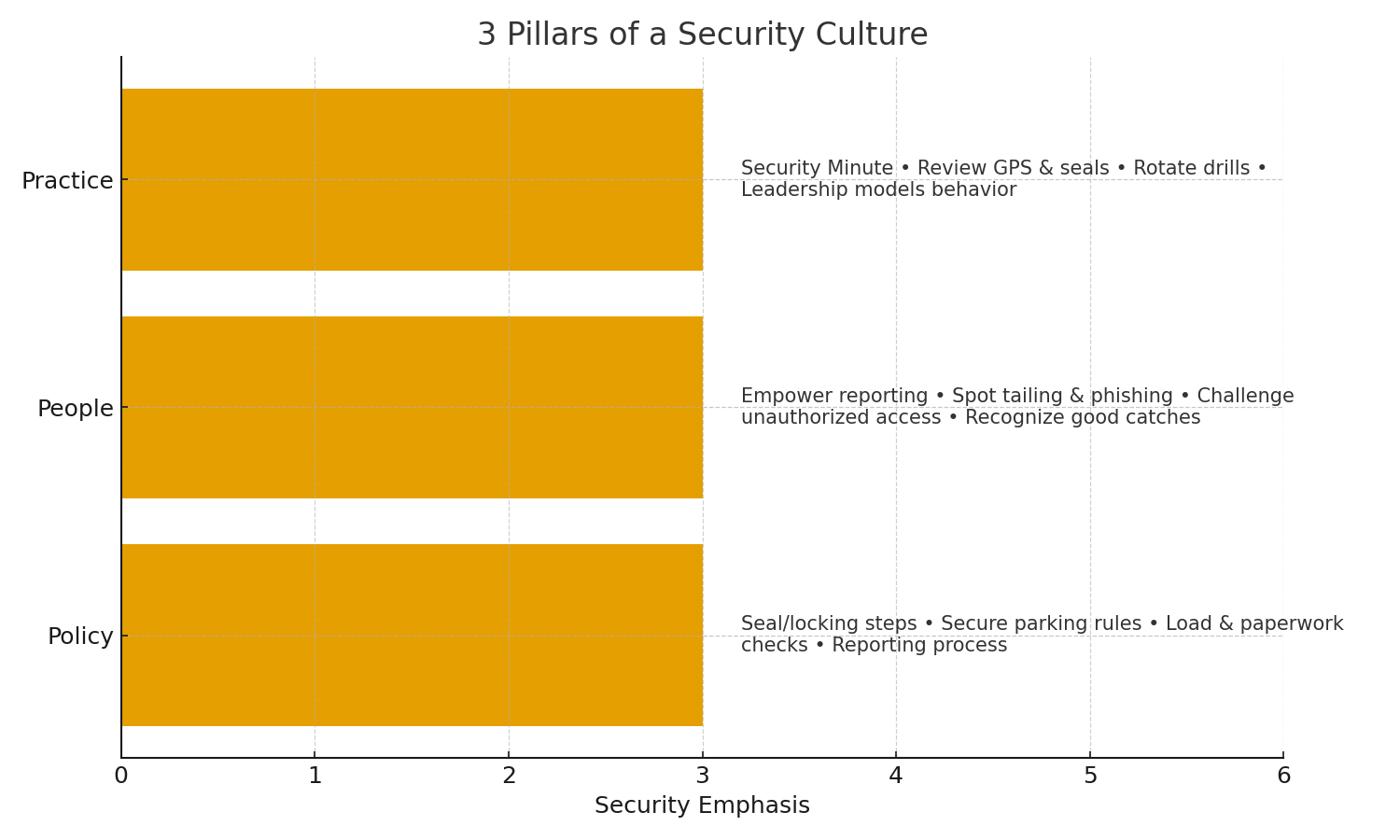
3 Pillars of a Strong Security Culture
- Policy
A written, shared policy sets the tone.
It doesn’t need to be fancy — a two-page “Cargo Security Plan” can spell out who’s responsible for what, how incidents are reported, and what expectations exist for:
- Locking and sealing procedures
- Secure parking and rest stops
- Load verification and paperwork checks
- Communication protocols for suspicious activity
Keep it simple and train on it at least once per year. A signed acknowledgment form helps with compliance and, yes — impresses insurers.
- People
Your drivers and yard staff are your eyes and ears.
A culture of security empowers them to speak up — and rewards them for doing so.
Encourage drivers to report red flags without fear of blame, such as:
- Being followed after pickup
- Strange vehicles at rest areas
- Unauthorized access attempts at terminals
- Phishing or scam dispatch emails
When people feel heard and protected, participation skyrockets.
- Practice
Culture sticks when it becomes habit.
That means reinforcing it through training, reminders, and leadership modeling.
Practical ways to keep security top of mind:
- Start monthly meetings with a “Security Minute.”
- Recognize drivers who followed protocol during a close call.
- Review GPS alerts or seal discrepancies together as a learning tool.
- Rotate security drills (like simulated theft attempts or cyber scams).
Each small step builds muscle memory — and that’s what keeps losses low.
The ROI of Security Culture
Security isn’t a cost — it’s an investment that pays dividends across operations:
| Benefit | How It Helps |
| Lower theft losses | Fewer claims, fewer interruptions |
| Safer drivers | Reduced confrontations and stress |
| Stronger customer trust | Repeat business from shippers |
| Better insurance terms | Preferred rates and deductibles |
| Higher morale | Pride and accountability on the team |
ATRI’s report shows that fleets actively training on theft prevention saw up to 40% fewer incidents than those that didn’t — even when running similar routes and cargo types.
How Insurers View “Security Culture”
Underwriters are people too — and they notice the difference between carriers that manage risk and those that react to it.
A documented security culture demonstrates:
- Predictable behavior (less uncertainty = less risk)
- Awareness of emerging threats (e.g., cyber and strategic theft)
- Compliance readiness (FMCSA and TSA expectations)
- Fewer claim disputes (thanks to evidence-based documentation)
If you can show your security training logs, policy acknowledgments, and incident reviews, you’re telling your insurer: we’re not just insured — we’re managing risk.
That’s how you turn compliance into savings.
Culture Protects Everything You’ve Built
For small and mid-size fleets, cargo theft can feel like an impossible problem — but culture costs nothing and pays back daily.
Every driver who double-checks a seal, every dispatcher who verifies a pickup, and every manager who reviews alerts adds another layer of protection.
Because protecting freight is more than part of the job — it’s protecting your livelihood.
At Jump Trucking Insurance, we help fleets combine smart coverage with proactive risk management — so your team, your trucks, and your cargo stay secure mile after mile.
Protect your freight. Protect your people. Protect your future.